Special Message


Showing posts with label pork. Show all posts

Monday, June 3, 2013

Orecchiette with Broccoli Rabe and Italian Sausage

Edited June 4th 2013 @ 10:15am
A friend left me an email late last night saying that I may have mistaken something else for the broccoli rabe in this post. Even as I clicked on the link within the mail and read the Wikipedia page on broccoli rabe (which I had read once before I actually set out to hunt for my first ever bundle of broccoli rabe or rapini), I was still pretty convinced (but very panicky) that I had got the right broccoli rabe. So I went through a quick mental checklist. The broccoli rabe has...

  • a different appearance from the regular broccoli CHECK
  • baby florets and long stalks  CHECK & CHECK
  • a similarity in shape to the Chinese kailan CHECK
  • ruffled, spiked leaves surrounding the florets Hmm, I don't remember seeing much of these in that bundle of greens that I bought...
  • a delicate bitterness Erm... definitely not. Those of mine were actually sweet! Oopsssss


So I went on to check on something else - baby broccoli. Uh-oh... it was indeed baby broccoli or broccolini that I had gotten myself that day. Here's a link to a neat description of broccolini, a hybrid of broccoli and Chinese kailan. 

And here's a link to a page that compares all three - broccoli, broccolini and broccoli rabe; and another one here that does a real great job at clearing the air.

Here I am with a confession to make - I have got it all so wrong! It really should have been broccoli rabe in place of the broccolini used in this recipe. Pardon me, my huge mistake! 

And here's to you, Huey Fang! Thank you for pointing it out to me!


I recently added this book to my cookbook collection - the MasterChef Cookbook. Browsing the new and barely 2-month-old bookstore here in the neighborhood (which by the way, where have all the bookstores gone?), it didn't take me long to decide that I wanted this. Love at first sight? Pretty much yea! It features the recipes to the many winning dishes by the final 14 contestants and judges - Gordon Ramsay, Joe Bastianich and Graham Elliot.

And what really caught my attention with just a very brief flip-through was how they each comes with neat instructions and real attractive photos - that even as an amateur, these are the scrumptious dishes that you can always try creating at home rather easily.


Even before I actually paid for the book and officially made it mine, I had already started bookmarking the pages mentally - "Woo, the Egg in Purgatory!", "Egg en Cocotte with Mushrooms and Brioche Toast!" (and there I gestured for my hubby to come over with a "psst" and we started salivating over the food photography together), pasta! (and you'll be surprised how even the simplest kind like the Linguini Aglio e Olio looks so much greater and made to sound totally doable in the book) and a whole range of seafood! The book is that good! Well at least it is at first glance...


This Orecchiette with Broccoli Rabe and Italian Sausage marked the first recipe that I tried out of the book. I have never had anything close to this before, so what made me choose this over everything else in the book must have been its simplicity and how it looks so attractive despite having just three real simple ingredients - the pasta, broccoli rabe and the Italian sausage.

A recipe courtesy of Joe Bastianich, I would say that it is indeed a simple dish at its best! Quoting his actual words from the book -

"An outstanding dish shouldn't be overly complex. Often the best ones are made with only a handful of ingredients. For example, this pasta recipe contains little more than broccoli rabe and sausage. The delicious simplicity of authentic Italian food is what we are looking for. When you think you have enough ingredients, take two out!". 


And simple and outstanding this dish sure is!

Wednesday, March 20, 2013

Pork Noodle 猪肉粉


Cravings alert! Yea, that's how bad it was! My craving for this pork noodle has always been there left unattended, well technically ever since I moved here. But each time it hit, I would usually manage to brush it off, distracting myself making do with plenty other options - settling especially on those that are not as much of a hassle in their making and of course a lot less time consuming too.
But having seen Sonia (Nasi Lemak Lover)'s post on her 新山粿條湯 Pork Kuey Teow Soup (Johor style), that craving couldn't be crushed any longer! So Sonia, thanks for the real good push! With streams of photos so attractive in her post, it's just hard to convince myself (and especially my tummy) that we can and should still wait until our next trip back to Malaysia for a bowl of this swine-centered goodness.

Pork noodle is especially my dad and my brother's all-time favorite. They just love everything with pork! Mom - she's the total opposite of them. She despises almost everything with pork! Me - I got a bit of both. My affinity for them does comes with a limitation though; anything beyond lean is a strict NO, and liver is the only innard that I tolerate pretty well.


Me and the liver - that story started when I was first told that I needed a boost in my iron consumption. So I started taking pork livers and cockles! Took me a couple of trials (and rejections), but eventually I have decided that the liver's not bad and cockles are amazing! So, some kinda acquired taste in both cases? Maybe...

A bowl of pork noodle usually comes with all the essential pork-based ingredients - there's the thinly sliced pork loins, minced pork and pork meat balls. A step up the adventure ladder and you get the liver slivers, intestines and kidneys. Of course, all these come tailored to your order; you can opt for some and exclude the rest. Served with some greens on the side [most of the time the Chinese mustard green (choy sum)], each bowl comes finished with some crispy fried garlic (essentially with their oil) and the crispy pork lards. So artery clogging! But still I can't help having a weak spot for them!


Having an extra egg is optional; but I certainly wouldn't object to having that beautifully poached egg topping a bowl of this pork noodle. And when you finally do breach the protective layer and get the runny yolk blended into the broth... gosh! A classic case of taste buds overloading!

Ultimately the broth that bathes all the ingredients in the bowl of pork noodle is what makes a stall selling this different from another selling exactly the same. Made with what must have been loads of pork bones simmered over a substantial amount of time, the resulting broth is one so flavorful it's just hard to miss the natural sweetness infused in it. And that is how the real good ones defined.


This homemade version incorporates the ribs and some vegetables that are sweet in nature in its broth making. It does come with a light difference compared to those 100% porcine-based broth, probably with an extra light hint of vegetables while missing the slight cloudiness and murkiness coming naturally from the heaps of pork bones. But this version inspired by Sonia is great nonetheless! Sweet (nothing artificial, of course) and flavorsome! And the good news? It has got my immense cravings for this pork noodle totally checked!

A mental note to myself - my next try would be a broth made with plenty of just the pork bones and nothing else and I'll see how that turns out... *evil grin*.

And now... let's get to the making!

Friday, March 15, 2013

Stir Fried Snow Pea Sprouts 清炒豆苗


Something green to balance the blog! I'm generally a big fan of greens, but these snow pea sprouts are not something that I have come to adore all along. It's pretty much one of the many things that I didn't know how to appreciate when I was a kid and only learned to do so growing up years later. I wonder if this change in taste is one of the things that really comes with age lol.

These snow pea sprouts are the immature tips of the snow pea plants, harvested when they have just started blooming and growing, before the reach the maturity level of a shoot even. This is how the cultivation is according to my own understanding (and please do correct me if it's wrong in any ways) - seedlings > sprouts > shoots > full grown plants where you get the snow pea pods. Interesting...


A delicacy in many places, these snow pea sprouts do not come cheap. Relatively, I mean. Which, is kinda justifiable considering how they are specially cultivated for the sprouts and shoots, and never the mature plants for the pods. Price aside, these are microgreens springing with life, naturally packed with flavors and loaded with nutrients. High in protein and fiber with negligible calories, they're all just too good to be true, are they not?


Young and tender, they hardly need much time exposed to heat to get them cooked and ready to be served. My definition to a plate of snow pea sprouts well done - it retains its natural tenderness with a crunch and a tad of nutty flavor. I personally like them stir fried with garlic, loadsa garlic to be exact lol. Healthy, tasty and refreshing, these sprouts with a vibrant green is just perfect in spicing up and balancing a meal, anytime!


Thursday, March 14, 2013

Pork Ribs with Bean Curd Sticks Soup 腐竹排骨汤


A classic soup that I grew up having at home, this is by far one of my mom's regulars, my brother's favorite. Mom's version comes loaded with whole white peppercorns and I used to dislike this soup for that particular reason. Nothing to do with its peppery nature; in fact I loved the kick! I just happened to really hate those chances of me biting into them randomly with every mouthful of soup that I took, especially those hidden in between the many foldings of those bean curd sticks.

So while it continued to make an appearance at home, I would usually give it a pass. Nope, I didn't even resort to just having the soup plain and simple - no ribs, no bean curd sticks, nothing at all; there's always a risk of stumbling upon a peppercorn still! Is there a term for the phobia for peppercorns, by the way? I think I must have had that! lol.

Things took a turn for the better when mom brought home with her something new for her kitchen collection - the stainless steel wire mesh ball! This has got to be the best invention ever! lol. So thereon, no more loose peppercorns swimming around in the pot, and especially none gone hidden anywhere at all. Now stress-free, I then declared myself a fan too!


Moving here, it didn't take me long before I found myself in the kitchen preparing the ribs, soaking the dried bean curd sticks, pitting the dates and crushing the peppercorns. Yup, just everything my mom did, all in the effort to make my own pot of Pork Ribs with Bean Curd Sticks Soup 腐竹排骨汤. And the good news? I have mom's wire mesh ball with me! Tadaaa...


Cute little thingy huh? lol. I'm not sure if mom eventually bought another one for herself after that replacing this, but this has ever since been a little treasure of mine. One that comes with a memory no money can buy, no time can erase...

Quoting from my previous post on the White Radish Soup 白萝卜汤,
"The longer the soup is left to simmer, the better it will be infused with all the flavors coming from the different ingredients. The water level will drop slightly as the simmering goes on but additional water will be unnecessary unless the water content has really decreased considerably. I would maintain it around 4-5L. Should you need to add in more water into the pot, make sure you add in only hot boiling water to ensure that the simmering does not get disrupted with the water of a different temperature. Add in just slightly more than enough to cover the ingredients comfortably. Any more will have the soup diluted rendering it less flavorful. If you are left with enough leftovers from this for the next day or two (I always do! lol), you will be amazed with how much better they taste after a night out. Try adding in some noodles of your preferred choice while using this as your soup base; you will have a good meal in a snap of time!"


And a few last notes to end this...
  • RECONSTITUTE The bean curd sticks come dehydrated in a pack. Before they are fit for the pot of soup, they have to be reconstituted in water. Depending on their quality and thickness, they can take some time in between half an hour and up to 2 hours. So do make an early start. Have them soaked in advance and leave them soaked until it's time to bring them into the pot.
  • COOK and TIME
    Different brand comes with different qualities and thus different time needed to cook them well and thorough. Some get cooked in a matter of minutes, others are just way tougher against heat and water. So you may want to get to know the ones you are using. If you have found a good one, stick to them.

    Get the soup base with the pork ribs started first (while the bean curd sticks are getting soaked). Add the bean curd sticks into the pot of soup and simmer with the rest only for the last two hours prior to serving. If you are unsure of their quality and texture, check them out about half an hour after adding them in. Well cooked and all soft - you should just stop the simmering there and then; intact and tough - let the simmering continue and recheck half an hour later.

    Keep watch to avoid over simmering; they break the bean curd sticks up. The taste will still be there, just not the mouthfeel, not to mention the not-so-appealing appearance in the end. Just for the record, mine took about 1½ hours.


Wednesday, February 13, 2013

Somen in Pig Maw and Chicken Soup 猪肚鸡汤寿面 #2 - Chinese New Year Series


This is an extension to the previous post by the same name Somen in Pig Maw and Chicken Soup 猪肚鸡汤寿面, or an updated post on that specifically. A tradition of the Hokkien or Putien Henghua people 兴化人, this is what hubby grew up having at home, especially on the many auspicious days we Chinese do celebrate and plenty other normal days in between. A closely related version to the Mee Sua soup 面线汤 that I grew up having at home, the differences between the two lie mainly in the specific type of noodles used and the garnishing that comes with them.

Celebrating the Chinese New Year here in the States this year, I made it a point to bring this into the picture as part of our small celebration. The difference between this and the previous post on somen? Well this post will be an in-depth post on a more elaborated version of the somen, probably one that makes a better replica to my mom-in-law's version. It comes with a little more preparations yes, and a little more time needed for its making in general. Lets just say that the previous post will be what I call the simpler version to this. I'll still settle for that whenever I feel like having somen in a snap on some random days, and I'll go for this on days when I have the little extra time to spare for something a little fancier maybe. Specifically, they differ in terms of...
  • The chicken breast Instead of serving the chicken breast as a whole, I have them out of the pot of soup about an hour before serving and shred them fine.  
  • The greens Previously I had blanched the Chinese mustard green (choy sum) and served them plainly as it is. This time I have them stir fried with some fresh shiitake mushrooms and sliced fish cakes before topping them onto the bowl of somen.
  • The garnishings Mom-in-law's version always come garnished with some crispy fried fried seaweed of some great quality. Not there in my previous post, but it is this time. And yes, it does make a whole lot of difference! lol.
  • The soup In terms of the pig maw and chicken soup, apart from the different types of mushrooms I incorporated this time (button and straw mushrooms as opposed to the enoki previously), they are all otherwise the same. 


Quoting from my previous post on how to clean the pig maw:
1. Trim off any visible fat on the stomach lining.
2. Inverting the stomach cavity, scrape the lining with a butter knife, mainly to remove as much slimy impurities as possible. This is where it takes up most of the time with cleaning a pig maw. So do practice a little patience here, because once this is over, you are pretty much done. Keep the scraping going - rinse occasionally, and repeat all over again. My cue to stop? When you get less and less from scraping, you hold it better with hands (especially with the slime lessening over time) and the smell gets more tolerable.
3. It should be good to go now, but I usually do end mine with a bout of dry rubbing with corn flour in and out to remove whatever it is capable of removing, followed by a good rinse after.
4. Repeat the dry rubbing now with a good amount of sea salt. Rinse with warm water.
5. Blanch the pig maw in a pot of water for a minute or two. The pig maw will appear to set taking the shape of a pouch. Remove from heat and drain.
6. Bring a wok or skillet to heat on high heat. Bring in the pig maw and dry fry it against the wall of wok or skillet (my mom's golden piece of advice - it should further reduce the smell of the pig maw which I indeed find true!). Turn and keep moving the pig maw around the wok or skillet until it dries up and the skin gets slightly browned. Set aside and let cool. When cooled down enough, cut into pieces. Be sure not to slice them into pieces too small. Moderate size always gives better texture (I will recommend pieces measuring about 2"x1"). Set aside.


Monday, February 11, 2013

Hokkien Spring Rolls 福建春卷 - Chinese New Year Series


Also known as the Lor Bak 卤肉 to some, this has always been a must to me on Chinese New Year. I'm not exactly sure what the significance is; I just grew up getting used to the idea of having them as part of the meals on big festive seasons as this, probably a culture and tradition of the Hokkien. Oh yes, I am a Hokkien! lol. But on second thought, these spring rolls do seem to fit into the picture rather well. In China, the Chinese New Year signifies the beginning of the spring season and thus it is also known as the Spring Festival to some. Spring rolls in the beginning of spring, sounds kinda perfect in a way! lol.

These spring rolls is one that makes you hard to stop at just a single bite or piece. It always leaves you keep wanting for more each time! Well it is to me lol. There have been plenty of variations as to how they are done. At least I have seen all my relatives having their very own versions. Similar but not totally the same, they however carry the same concept - marinated minced meat rolled in bean curd sheets and served deep fried. Some are made with pork while some opted to have the shrimps added in. There's a version with just the meat rolled in; there's another version with bits of vegetables incorporated in it - water chestnuts, carrots, spring onions or the onions maybe. And to complicate matter a little further, everyone just seems to have their own seasoning formula! Complicated or flexible, I think the terms go interchangeably in this matter lol.


Starting our very own family tradition here this year, I made it a point to include these spring rolls in our menu too. The good thing about these spring rolls is that they can be made in a relatively large batch and frozen them up for later consumptions. So when you have had that done and stored away in the freezer safe and sound, knowing that will hopefully leave you with a little peace of mind as you continue getting yourself busy working on the plenty other meals throughout the Chinese New Year celebration. It sure did work on me! lol.

To my many readers who have witnessed my progress and development ever since I started this blog, I thank you so very much for the endless support to keep me going! Even that seems so inadequate.

And particularly to those who celebrate the Chinese New Year, Happy Chinese New Year!
 新年快乐,心想事成,蛇年行大运!


Friday, January 25, 2013

Homemade Mee Hoon Kueh (Hand-Torn Noodles) 面粉粿

A post rather similar to the Flour Noodle Soup (Pan Mee Soup) 清汤板面, this was made to satisfy my sudden craving for a bowl pan mee out of the blue. So sudden I hardly had all the ingredients I needed to make this our dinner that day. Yet I wasn't quite that keen on making a trip out to get them all. With some store bought flour noodles left barely enough for an individual serving, I resorted to making my own dough this time. Not my first time, but definitely one that I have not done for a while now. Probably so since I have found the commercial pan mee that I got so contented with, one that I still think is somewhat comparable to those home made ones as mentioned in my previous post.

The good thing about making my own? I guess rather than having the usual thin and round noodles 幼面 that I regularly made my pan mee with, I can opt for the hand torn version of pan mee this time around. mmMMmm, suddenly all my taste sensations just felt so awaken simply picturing a bowl of this mee hoon kueh lol. Not having the "manicai" with me, I have that green substituted with the Chinese mustard green (choy sum). And instead of the fried baby anchovies that I previously used, I made a batch for garnishing with the regular kinds of anchovies. Simple variations, minimal changes, huge satisfaction!


Saturday, January 19, 2013

Crispy Spring Rolls 香脆春卷

A street food that I have always loved as a kid, the idea to making these at home is one inspired by my mom-in-law. Probably something that is made easier naturally with skills and experiences, my mom-in-law sure had made the whole making process seem simple enough, one that is totally doable at home. That bit of memory and the little wrapping experience I have had with her was what started me with my first batch of homemade crispy spring rolls soon after I moved here. My first batch was the vegetarian version of spring rolls, pretty much a replica of hers. The idea of tweaking the filling along the way came later when I started getting more comfortable with the basic concept of making these spring rolls.

Made slightly different to include some meats this time around, this was a batch specially done when I had the impulsive idea of making and bringing hubby and his colleagues some finger food as the working week was coming to a close yesterday. I would personally think that this is more of a Malaysian version of spring rolls to have included the jicama, mushrooms and dried shrimps especially. This being a different version from the usual popular Chinese spring rolls here in the States, I was indeed a little concerned if hubby's colleagues would find these acceptable. Lets just say that my worry was proven unwarranted in the end lol.


Some personal notes:
  • A well drained filling makes a good filling. Make sure that they are cooled completely before being wrapped. Any excess moisture uncared for makes soggy spring rolls, some leaky ones even.
  • Once the spring roll wrappers packaging is opened, they dry out almost instantaneously. That makes them a lot less pliable and wrapping almost impossible. Be sure to cover the wraps with a damp cloth whenever they are not in use. That maintains their freshness at their best.
  • Likewise, readily wrapped spring rolls will have to be covered and protected from drying out prior to frying. Try to leave some gap in between each roll separating them. Leaving them in contact will make them adhere to one another over time and separating them will not be easy. If you have to stack them up, separate the layers with a piece of parchment paper or plastic wrap until frying time.
  • Wrap the rolls neat and tight. So less is more in this case! 2 tbsps of fillings in a roll seems to fit just well. That makes sure that the roll stands no chance to leak either as it gets filled or fried later. Plus your guests will get to eat elegantly! lol.


Friday, January 18, 2013

Tricolor Steamed Eggs with Minced Meat 肉碎蒸三色蛋

This tricolor steamed egg was one of the first dishes that I tried making when I first started in the kitchen. Back then the idea of getting a bowl of silky smooth eggs had never crossed my mind, at least not with my first few trials. One that tasted good and right was all that I was aiming for. It was after I had got that taste and flavor parts right did I start paying a little more attention to the details that come with steaming eggs. Things did not come quite as easily though. I had had a good number of bad experiences with this; some was so wrong they had to go into the bin coming out of the steamer. 

Soon this steamed eggs started to feel very much like a piece of art itself. And when you finally get to open the steamer lid one day to reveal a velvety smooth eggs steamed to perfection, it will first be the self satisfaction and pride that get you so overwhelmed before anything else comes next. So much so that spending a good amount of time admiring the piece of work of yours quietly is almost always guaranteed before you can make do with the idea of presenting it away and indulging it next.

My two cents' worth:
  •  Having three different kinds of eggs will have really sufficed in making a good dish out of these. It is totally a personal preference that I love adding a touch of meat to enhance the general texture this dish takes. A bite in between the velvety smooth eggs - not too bad an idea, no? lol. Have them lightly stir fried with some minced garlic prior to steaming makes sure that the meats are at their best presentation, taste and appearance wise. 
  • The right amount of water to be used is to me a crucial issue that also poses as the biggest challenge I had had. My thumb of rule? Maintain a ratio of water:beaten egg at 1.5:1. Add in only bubbly warm water (not boiling hot). That will make sure that no time and heat will go wasted in regulating the internal temperature when put to steam later. 
  • The right heat to be used really does depend of your steaming apparatus. Settle for the lowest heat that your steamer can manage. This will mean a level where a continuous stream of steam can be seen. In my case with my electric stove top, I needed one close to a medium heat. Any lower and the steam flow will get disrupted as the element heats and cools periodically. So do adjust that part accordingly. 
  • Time needed will vary depending on the serving size and heat supply. Make the first 10-minute your first check point. Remove the lid (the steam needs some escaping which will do good anyway) and check the eggs. 
    • Watery? Let steam and recheck 5 minutes later.
    • Wobbly and looking set but not totally? Give it another 2 to 3 minutes.
    • All set and looking smooth and silky? They are good to go!
Sounds a little challenging, do they not? But this is one so worth mastering because once you have got the concept right, steamed eggs regardless of which variation you opt for will never look the same again!

Sunday, January 13, 2013

White Radish Soup 白萝卜汤


One of the few favorite soups of mine, this has been one that shows up rather regularly on our dining table ever since I started in the kitchen. Making Chinese soup has always been something relatively easy needing little skill. Some past dining experiences or a little imagination with how and which ingredient will go well with what others will surely help a big deal however. That little bit plus I have in me has got to be attributed to the many years of my mom's home cooked food I have had growing up at home. Likewise, this has been one of mom's regular too. Over the years whenever we had this served as part of our meals, mom would naturally start reminding us of how this particular white radish soup works exceptionally well in cleansing and detoxifying our digestive system, just exactly what we needed every now and then. Where and when has she got this piece of information from, I have little idea really lol. But despite having not a fact check done on it ever, I have always loved this soup for how simply tasty and refreshing it is nonetheless.

While I have never really tried studying the nutritional values these radishes have in the past, I do find myself accepting the claim mom has always had more than alright. One thing that I have never failed to notice myself each time I happily dig into the mounts of white radish chunks in the soup will be how extensive the mesh of fine lines within the radishes is. These lines are made visible to the naked eyes and I supposed they do get more prominent the longer the get cooked, turning translucent. Whether they are the digestible or indigestible fiber or both, they must be the very contributors to whatever digestive system facilitation these radishes have on us. That aside, taking a brief look on the white radish introduction anywhere will reveal that they come packed with a considerable good amount of the immune booster we all need, the Vitamin C. Low in calories with virtually no cholesterol, they naturally present themselves as a very good dietary option for many.


Commonly boiled with the pork ribs, mom's version always comes with a handful of white peppercorns in a wire mesh -  a little heat to balance the cooling nature white radishes have. This is definitely one particular addition that I have always accepted happily for the extra kick and spice coming from these peppercorns. With a touch of sweetness coming from the presence of red dates and an extra flavor coming from the dried oysters or the dried cuttlefish, they collectively make a hearty bowl of soup so comforting and nutritious anyone will easily appreciate on any days.
 

Friday, January 11, 2013

Szechuan Dry Fried Green Beans 四川干煸四季豆


My liking for green beans did not come until way later in life when I started getting slightly more health conscious and soon finding myself either consciously or subconsciously getting rid of the forever bad habit of my picky eating. Like plenty other kinds of vegetables - the bean sprouts, okra, brinjal, bitter gourd and the list just goes on, these are some the many many treasures that I have come to appreciate only when I had finally managed to knock some senses into me years ago. And while I have since neither particularly despising them nor especially liking them any more than I should, my first dining experience in a Szechuan restaurant in Chicago by the name of Lao Sze Chuan was what made me actually fell in love with green beans particularly when they are prepared this very way - dry fried with bits of ground meat and came packed and so full with spice and flavor! 

Not to be deceived by the tiny pinkish red flower-shaped spice used in the making of this dish, the tongue-numbing Szechuan pepper is definitely one not be to underestimated. Uniquely aromatic, they probably make the very spice that defines the dish, alongside the heap of dried red chilies, garlic, ginger and spring onions that present themselves harmoniously with one another and more importantly with the plate of greens on the whole. Fresh and crunchy green beans retaining their texture even after cooking, having the ground meat and an additional touch of dried shrimps work exceptionally well in enhancing the mouthfeel as you dig into the dish. And with the inclusion of a tinge of the chili bean paste, they simply do their best at contributing wonderfully to the striking flavor Szechuan cooking always has.


While the version that I had had dining out was one made with the Chinese long beans or the yardlong beans, these long beans are one that I do not always manage to get hold of here that easily in the area where we lived. My next best options - the green beans. With the slightest difference in texture (thinner, more compact and slightly crunchier with the long beans), the green beans do make a very good interchangeable alternative to those. The beans, regardless of which is used, are usually dry fried or sometimes deep fried even. For a healthier option, par-boiling and steaming before stir-frying the beans should work just as well. But as far as the concern with frying the beans goes, this is one dish that will worth all the effort and the occasional sinful indulgence for its seriously likeable presentation.

Saturday, January 5, 2013

Pork Congee 猪肉粥

A nostalgic favorite of mine, making this pork congee had surely brought back plenty of the sweet memories I have had growing up. Memories of the many many uncountable bowls of pork congee that I had had with my dad and occasionally with my brother at one particular place back in my hometown, Kuantan. Sadly this particular shop right opposite the main post office in town had been out of business for quite some time now; memories, however, hardly fade once they get etched in our hearts. Moments of reminiscence, so please do pardon me. Back then we were the few regulars of this particular stall run by a loving old couple specializing in none other than their one and only specialty - the pork porridge. No orders were ever needed whenever we went; they knew just too well what we had come to love and adore after the first few visits that we made. Once seated down, the wife would come and line our cutlery ready on the table with the daily newspaper in hand to keep us occupied while the husband would be setting off cooking our porridge in swift movements, bowl by bowl.

There probably were nothing super WOW about this bowl of congee that I grew up knowing and eventually loving, but it had always brought us comfort unfailingly. And soon that became one of dad's and my favorite breakfast place to frequent (but then again, did I not ever have to attend school most mornings? Well they probably were those weekends then. lol.). A humble stall in a huge restaurant with plenty other stalls selling a good selection of other breakfast, every bowl of porridge the husband made was one that had been consistently good all the years. Despite being a real simple bowl of congee, it had always left us with not a single issue that we would have wished it done any differently from how he had always had it done. It was to me a bowl of heart-warming congee that could not have been any better than it already was.


Some homemade irregularly shaped fresh meatballs made from minced meat, thinly sliced pork loins, a small selections of pork innards (the intestines and livers among the few) which of course would only appear in your bowl of congee upon a personal order and a few springy and bouncy pork meat balls all topped with some finely shredded lettuces, each bowl was made complete with a small handful of the crispy fried shallot and a round of their precious aromatic oil for an enhanced flavor plus a few pieces of bite sized crispy crullers. And to top everything off, each bowl came with an egg cracked right into the middle of the bubbling hot bowl of congee. With a few light dashes of white pepper powder, that simply made the perfect picture to a perfect bowl of velvety smooth pork congee, at least to my very own personal definition.

Thursday, January 3, 2013

Sweet and Sour Ribs 糖醋排骨

Sweet and tangy with a tad of tartness, it simply is hard to find something not to like about this sweet and sour ribs really. I stumbled upon this recipe by Yi from YiReservation while I was looking through lots and lotsa posts on the Malaysia style of sweet and sour ribs, better known locally as the "pai kuat wong" 排骨王 - a personal favorite of mine that I have adored forever now. Having seen and read through his page featuring this different version of sweet and sour ribs, it really did do a very good job at having me well convinced to have my attention slightly diverted from my original plan and give this very recipe a try instead. And WOW,  with just one or two very minor changes fine-tuning this to my personal taste preference, not only was this a much better call to answer and satisfy my craving for the childhood favorite of mine, this version came with a pleasant twist to the one that I have always loved.

If you were one like me, who do get a little disheartened with the tough and chewy bits of pork chops or ribs you do sometimes get from ordering the "pai kuat wong" 排骨王 (but they usually will still be good taste-wise that I probably will complain for just a short minute, happily chewing the next lol), then this is one that will simply make you so amazed just as soon as you have your very first bite at it. Succulent and fall-off-the-bone ribs so packed and rich in flavors, not only does this make a version so much tastier than my favorite "pai kuat wong" 排骨王 (ops, is that me with my loyalty taking a shift? Nah, they definitely will still be my pick dining out lol), this comes with another big plus in its making; while the conventional way of making the "pai kuat wong" 排骨王 always involves a round of deep frying prior to coating them with the finger-licking, thick-and-gooey sweet and sour gravy, this version comes braised over a duration of time instead. The outcome? One totally comparable to the other, if not better. Yes, that good! - minus the hassle of dealing with a good amount of oil for deep frying and all that splashing commotion, and of course the health-related concern that comes in a package with deep fried food too. Try it for yourself - kids or adults, this is one that anyone from all walks of life will easily fall for!


Sunday, December 30, 2012

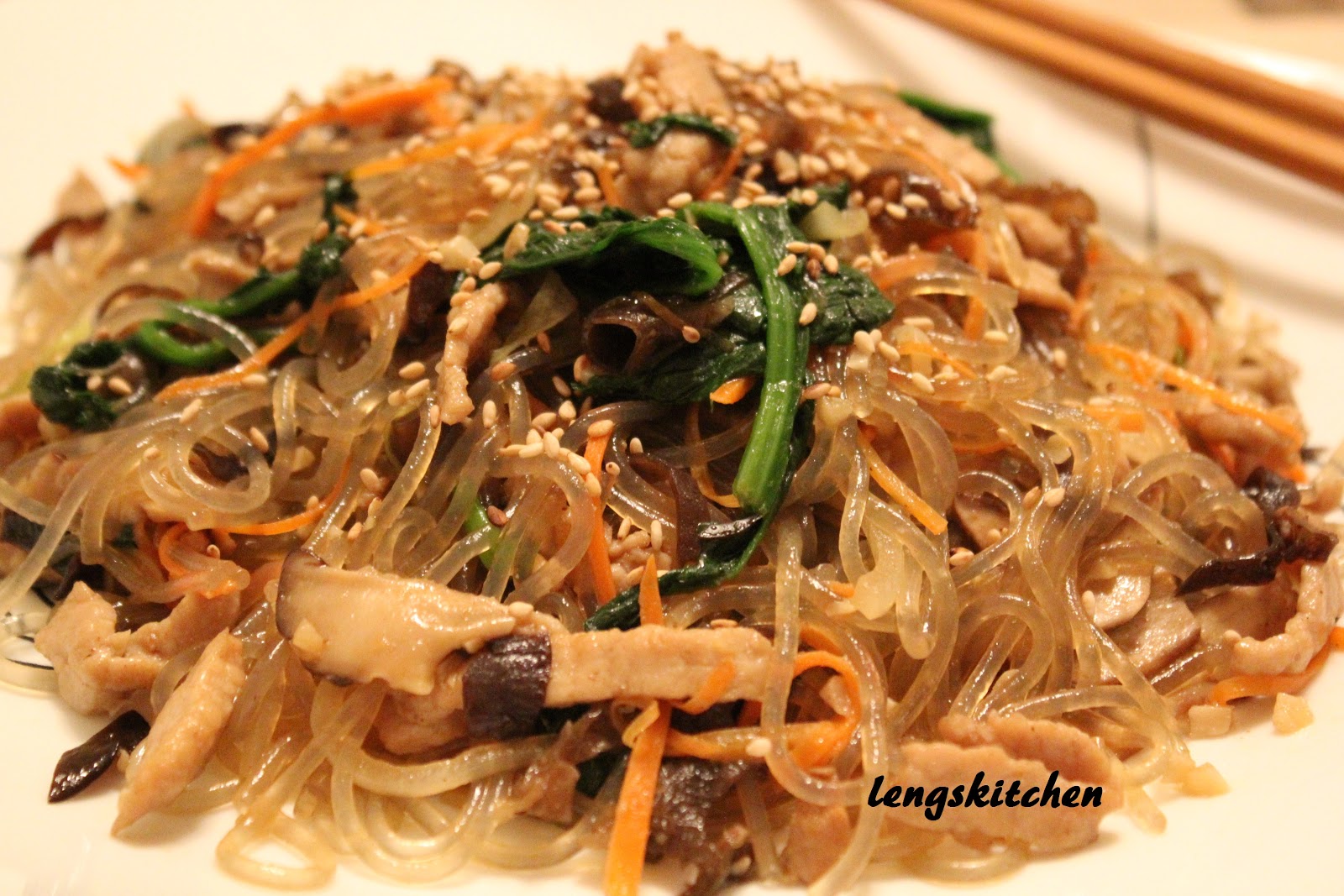
Japchae (Korean Stir Fried Noodles) 잡채

Japchae was one of the first few dishes that was introduced to me when I had my very first exposure to the Korean cuisine years ago. Despite its pure simplicity without anything really fancy in its making, this was one that had surprisingly left me with an exceptionally good impression - healthy, plain tasty, pleasant to the palate and very appealing to the eyes in fact. The delicate strands of sweet potato noodles come tender but not overly so, retaining its springy nature just so perfectly well. Tossed with a myriad of ingredients and some simple seasonings, the noodles adopt the richness of flavor coming from this whole combination. The end result - a plate of stir fried noodles with a distinctive pleasing texture and a touch of crunch plus the exotic combination of different tastes and colors, all in one. A light and nourishing dish to my personal definition, this is one in which a spoonful will always leave you wanting for more.


Thursday, December 27, 2012

Bak Kut Teh (Spare Ribs Soup) 肉骨茶

Being my dad and brother's all-time favorite, we have plenty of bak kut teh growing up and dining out with never a specific time to having them - they never are confined to just breakfast or dinner in particular. Lunch and sometimes even supper, it has always fit so well like no others. Having different versions of bak kut teh from town to town whether they are of the same or different origins, this one featured here has got to be the one that I am most familiar with - Hokkien style? I am not exactly sure myself. Apart from this being one with a broth tinted with a touch of dark soy sauce, I have had others that come clearer in general - some taste more peppery than others, some come with ingredients all loaded within one same claypot, and some will have the different ingredients served in small, separate portions each. And in some later years was when I was introduced to yet another version with a totally different dimension from any aforementioned, nothing like the conventional bak kut teh in fact - the dry form of bak kut teh. Rather than being soupy, this is served in a caramelized thickened gravy usually loaded with dried chilies and heaps of garlic.


If I were to describe bak kut teh as per my very own experiences with them, it will have to be a claypot dish on its own in which the pork ribs are cooked in a herbal soup base infused with a concoction of herbs and spices. Savory in general, the pot of soup with such a herbal richness is made wholesome and complete with the addition of other simple ingredients - assorted mushrooms (shiitake, button and enoki to name a few), fried tofu puffs, deep fried bean curd sheets and some greens, among the common few. Great served with a bowl of plain white rice, yam rice or the fried shallot oil infused rice, they go exceptionally well with a side serving of crispy crullers with birds eye chilies and minced garlic in sweet dark soy sauce as the dipping sauce on the side. Too big a picture to take in? Maybe lol. But when you have found a good place serving bak kut teh that suits your very own taste according to your personal liking, having bak kut teh has got to be one of the few that always comes a maximum satisfaction guaranteed each time. 


Making this at home comes rather easily especially when you have managed to recognize and get hold of a spice mix meant for making a good serving of bak kut teh. With that in hand and those few essential ingredients to be incorporated together, time will be the remaining factor before you have a pot of bak kut teh simmering away within your very comfort zone, filling your home with a lingering robust and intense aroma as the cooking goes on. Moving here, it was months later before I spotted the first pack of bak kut teh spice mix with a brand most Malaysian will be familiar with - Yeo's. One single try and I have ended up going back to the same Chinese grocer to stock up on these spice mix since. They are in fact the best that I have come to try thus far, and never could I have been more satisfied with the pot of bak kut teh that we do get at home these days.


Making bak kut teh at home is one that I have always made sure that they come more than enough for just a meal or two. The fact that they never fail to taste better the longer they are left to simmer makes it a reason good enough to be having the same for the day or two after. So do aim a little more than what your tummy can accommodate - chances are they will always leave you wanting for more as soon as you are done with your first round of bak kut teh!

Saturday, December 22, 2012

Somen in Pig Maw and Chicken Soup 猪肚鸡汤寿面


It officially marked the very first day to winter yesterday, so promptly greeted with the snowy weather that we had throughout the day yesterday. Returning from our anniversary trip to Las Vegas just the past weekend, hubby and I both are now again in our battle against the seasonal flu that we thought we had just recovered from not that long just prior to our trip - pretty much thanks to the sleepless nights and overindulging ourselves in the endless lines of great food, particularly the part on overdoing the liquor (oops). With our lifestyle going haywire in the sin city, the few crazy nights had surely knocked some consciousness into me at the end of the trip, something that I have to involuntarily accept now - that I probably am slightly beyond my age for those stuff ever again lol. Day 5 of feeling under the weather (and still counting), well this should prove that there must be some truth to that little fact check there, and that I should really be thinking twice before ever engaging myself in any of those again in the future. Sign of repentance? Oh yea, I bet it is lol.


We have an unusually cold weather here in Michigan yesterday, the lowest it has got thus far (but then again the tough days are just about to start! grrrrrrrrrrr). Feeling all so sulky on the whole, I guess it's a thing good enough that I have this little craving left stirring in me still - chicken soup! This somen in pig maw and chicken soup 猪肚鸡汤寿面 is pretty much a fusion of my mom's chicken soup and my mom-in-law's somen. Mom's chicken soup comes with a whole chicken cut into pieces, a variety of mushrooms, and dried scallops - clear and yet so very flavorful and nutritious it makes itself such a great comfort food on its own. Mom-in-law's somen on the other hand, has always been the iconic dish at home (in which the noodle represents longevity in general) especially to the many auspicious days Chinese do celebrate - Chinese New Year and birthdays among the few. Served with pig maw soup with some greens, crispy fried seaweed and deep fried shallots, this is a tradition of the Putian people, or Xinghua 兴化人, a Han ethnic group from Putian, Fujian - dad-in-law's origin.


Cleaning the pig maw is one that really only gets better with experience. I can never forget how my first experience with it turned out to be a real disaster. I spent some good four hours at it before I was convinced that they are good to be incorporated into my pot of simmering chicken soup back then. Your second try will naturally take a lot less time than the first and the next time you are at it again, you will then realize that you would have gotten the hang of it by then. But generally this is how I usually get mine done.
  • Trim off any visible fat on the stomach lining. 
  • Inverting the stomach cavity, scrape the lining with a butter knife, mainly to remove as much slimy impurities as possible. This is where it takes up most of the time with cleaning a pig maw. So do practice a little patience here, because once this is over, you are pretty much done. Keep the scraping going - rinse occasionally, and repeat all over again. My cue to stop? When you get less and less from scraping, you hold it better with hands (especially with the slime lessening over time) and the smell gets more tolerable.
  • It should be good to go now, but I usually do end mine with a bout of dry rubbing with corn flour in and out to remove whatever it is capable of removing, followed by a good rinse after.
  • Repeat the dry rubbing now with a good amount of sea salt. Finish with a good rinse using warm water. A little more boiling and dry frying (a little more elaborated in the recipe part as they come) and that is it! 
Tedious? Maybe, but practice really does make perfect. These days, it takes not much more than half an hour to get them squeaky clean. And the best part about it? Doing it yourself at home means you know exactly the quality of the pig maw you are getting into the pot of chicken soup and of utmost importance, what your family ingests as it gets served on the table later. So worth it!


Monday, December 3, 2012

Stir Fried Instant Noodles 炒即食面

Another weekend with not a particular craving in mind, just anything simple sounds and looks good enough to us as hubby and I are still coping with the overwhelming Thanksgiving dinner. Not keen on neither dining out nor getting myself busy in the kitchen as the weekend approaches its end, I resorted to what most students (despite me being a long gone one *blush*) turn to for an easy meal - instant noodles. My favorite version will be the Maggi mee goreng mamak (fried Maggi noodle à la mamak style) that I particularly loved having at mamak stalls in Malaysia. To catch sight of a packet of those curry flavored Maggi noodles is close to being impossible here where we live, but we have the Indomie instant noodle in abundance here instead. So different brand, different packaging, different taste but same cooking principles - they are basically the instant noodles stir fried using the noodles within the packet.

The Indomie instant noodles come in packages meant to be served as plain fried noodles - simply have them boiled and mixed with the seasonings and voilà - fried noodles delivered as instantly as promised. But while I am all leaning towards an easy night, I am still all in to make our dinner a proper wholesome meal still, or a rather balanced one at least. So with a little extra touch here and there, giving the final appearance a little color and extra flavor, you get a slightly more elaborated version of fried noodles that may leave your guests (in my case my hubby that is lol) not grasping even a trace of anything close to an instant quality after all.


Related Posts Plugin for WordPress, Blogger...